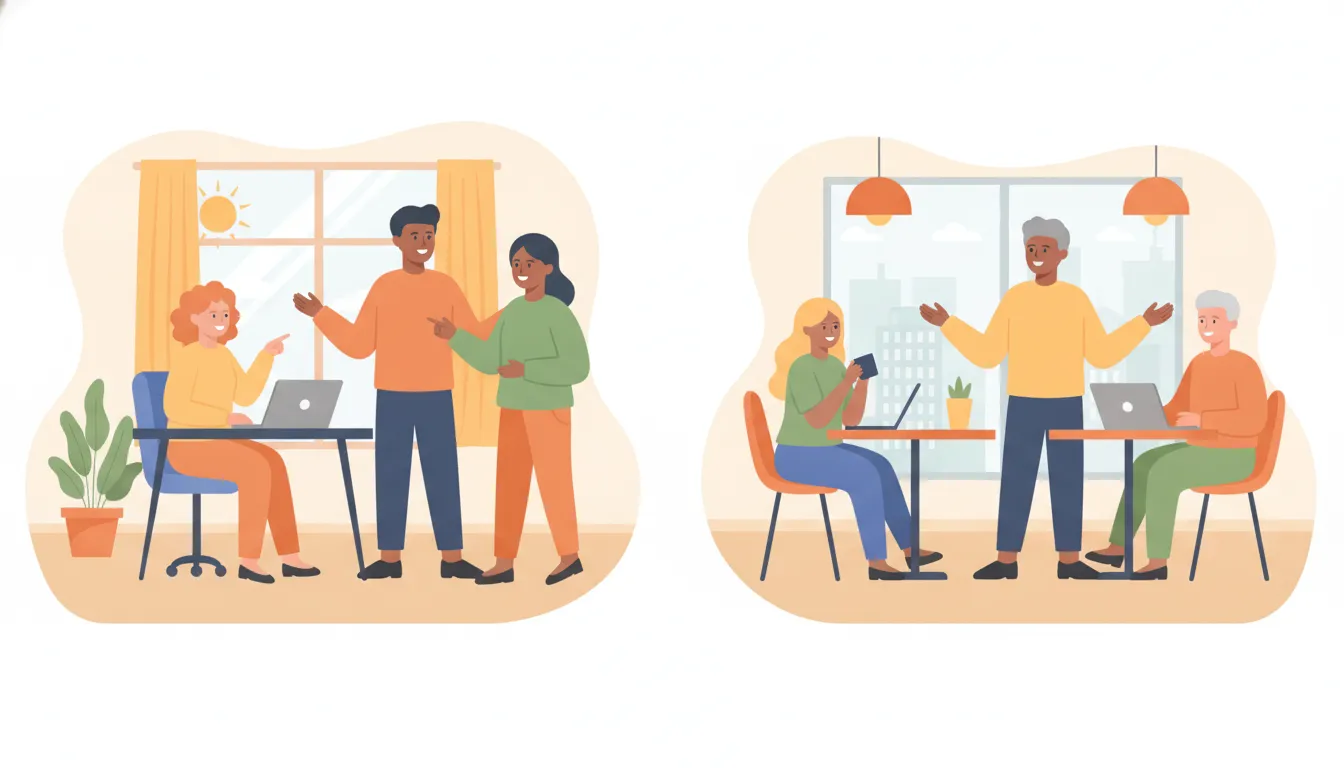
Hybrid managers rarely struggle because they lack leadership potential. More often, their routines were built for a workplace pattern that no longer exists. One week may include focused one-to-ones, informal office conversations, and shared planning. The next may depend on video calls, asynchronous updates, and teams spread across time zones.
Get your first leadership tip from Bunch.
The strongest leadership support for hybrid managers combines practical guidance, regular opportunities to practice, and timely coaching that fits the way work actually happens. Look for support that helps managers turn good intentions into repeatable habits, while giving them room to adapt those habits to different people, schedules, and situations.
The buying decision is more specific than choosing between a course and a coach. Assess whether support builds the capabilities hybrid managers use most. Check how easily it fits into the working week. Look for evidence that leaders are applying what they learn. Start by examining what the support should include.
What Does Leadership Support for Hybrid Managers Need to Include?
Hybrid managers work across changing schedules, locations, and communication habits. Their role is not simply to keep remote and office-based employees informed. They must set direction, lead through other managers, influence cross-functional partners, and create a fair team experience when people do not share the same daily context.
The right support should build judgment and repeatable habits, not just deliver information. An individual manager may need help before a difficult conversation, guidance on prioritization, or a short exercise that improves delegation. For HR and L&D, the question is broader. Can the support reach managers consistently, fit different work patterns, and show whether learning is being applied?
What should the support help managers do?
Start with the decisions hybrid managers make repeatedly. Strong support should help them:
- Set direction: Translate organizational priorities into clear outcomes, ownership, and expectations.
- Lead through managers: Coach other people leaders instead of becoming the bottleneck for every decision.
- Influence across functions: Build alignment when authority is shared and informal communication is uneven.
- Prioritize fairly: Make tradeoffs visible and avoid rewarding proximity or constant availability.
- Support inclusion: Notice whose voice is missing and create equitable access to information.
- Develop people: Give useful feedback and create growth opportunities across locations and schedules.
These capabilities should appear in realistic scenarios rather than abstract principles. A manager might address a performance concern with someone they rarely see, resolve disagreement between functions, or decide whether a meeting or written update is fairer. Support becomes more useful when it helps the manager choose and practice the response.
For HR and L&D, evaluate the operating requirements alongside the learning experience. Check mobile access, flexible content, privacy, and useful reporting. Individual managers should use support in the flow of work. Organizations should assess engagement, repeat use, application, and development patterns.
How Can Hybrid Managers Turn Support Into Daily Practice?
Support becomes useful when it meets managers inside the work they already do. A team meeting, feedback conversation, or difficult message can become a small practice opportunity. The goal is not to add another large program to a changing schedule. It is to create a rhythm that helps managers notice, try, and improve one behavior at a time.
MIT Human Resources recommends coaching throughout the year rather than limiting development to an annual review. Its guidance emphasizes two-way conversations, paraphrasing, continuous improvement, and clear next steps. That approach keeps support connected to current context.
- Choose one behavior. Start with asking better questions, clarifying ownership, or making meetings more inclusive. The behavior should be observable by the end of the week.
- Apply it in one interaction. Use the behavior during a one-to-one, project check-in, or asynchronous update. Notice who receives context in real time and who must infer it later.
- Ask for a two-way check-in. Invite a direct report to share what felt clear and what did not. Paraphrase the response before offering advice.
- Adjust the practice. Review what happened and identify one improvement. Bring broader patterns to a peer group, manager forum, or HR partner.
- Capture the next step. Note the behavior attempted, the team response, and the adjustment to carry forward.
Bunch provides personalized two-minute tips and scenarios designed for consistent leadership habits. Managers can use a short prompt before a conversation, then return to the situation afterward. Read these examples of daily leadership habits for a practical model.
For HR and L&D teams, the test is simple. Can managers access support when a real situation appears? Can they practice without disrupting work? Can they return often enough to build confidence? If so, support becomes part of the operating rhythm.
Which Coaching Support Helps Hybrid Managers Handle Real Conversations?
The best support prepares managers for conversations that cannot be solved with a script. A manager may address missed work, resolve tension between remote colleagues, or delegate a project without confusing ownership. Support should help them understand the situation and choose a useful next step.
MIT describes coaching as an ongoing, two-way conversation. Its approach includes listening, paraphrasing, continuous improvement, and agreed next steps. This pattern can build trust when tone and context are harder to read through a screen.
How can managers structure feedback without sounding scripted?
One useful model is CBIN: Context, Behavior, Impact, and Next Steps. A manager might say, "In yesterday's client meeting, the risk discussion moved on before the remote team member could respond. We missed important context. What should we change for the next meeting?" The structure keeps feedback specific while leaving room for the employee's perspective.
CBIN separates an observable behavior from a judgment about character. It can also support conflict conversations. A manager can describe when the disagreement occurred, name the behavior that affected collaboration, explain the impact, and invite a repair.
GROW provides another structure: Goal, Reality, Options, and Will. A manager delegating responsibility can clarify the outcome, explore confidence and constraints, consider approaches, and confirm the next action. This avoids vague autonomy and taking work back too quickly.
What does two-way coaching look like?
Two-way coaching means the manager does not enter a difficult conversation only to deliver an answer. They ask questions, listen for what is unsaid, and paraphrase before responding. In a remote setting, that might sound like, "I hear that shifting priorities make the deadline feel unrealistic. Is that right?" The employee can correct the interpretation.
Useful support lets managers practice these moves with realistic scenarios. Personalized tips, expert-curated scenarios, and on-demand AI coaching can reinforce the habit without requiring a long course. Managers can also review this quick leadership advice before a feedback or delegation conversation.
How Should Buyers Compare Coaching, Courses, and AI Support for Hybrid Managers?
The strongest model depends on what managers need between scheduled sessions. Compare each option by access, opportunities to practice, scalability, and accountability across changing work patterns.
| Support model | Strongest fit | Watchout |
|---|
| High-touch coaching | Complex situations and deeper behavior change. | Calendar, coach capacity, and cost can limit access. |
|---|
| Cohort or course support | Shared language, structure, and group momentum. | Scheduled learning may not help at the moment of need. |
|---|
| AI plus microlearning | Distributed teams needing flexible reinforcement. | Human judgment and peer relationships still matter. |
|---|
High-touch coaching offers strong personalization. It can help when a manager is navigating a sensitive performance issue or major role transition. Buyers should ask how often support is available and how learning continues between sessions.
Cohorts and courses create structure. They help managers learn together and discuss shared challenges. Buyers should ask how the program reinforces learning after a live session or final lesson.
AI support paired with microlearning fills the space between formal development moments. Bunch combines two-minute tips and scenarios with more than 500 expert-curated tips and scenarios. Bunchee provides 24/7 AI coaching for leadership challenges.
That combination does not replace human judgment or meaningful peer relationships. It provides a practical layer of support before a one-to-one, after a tense exchange, or while preparing feedback. For more context, explore AI coaching for leadership development.
What Should HR Measure Before Scaling Hybrid Manager Support?
Before expanding support, HR should define what adoption and progress look like. A high registration count can hide a program that managers rarely use. Satisfaction can coexist with little change in delegation, conversations, or team connection.
Use a measurement ladder. Start with leading indicators that show whether support is accessible and becoming a habit. Then track application and behavior. Finally, review lagging indicators that show whether those changes help teams work better.
Which leading indicators show that support is becoming a habit?
Track participation by manager, team, location, and work pattern. Look at activation, weekly use, and the percentage of managers who return after the first week. Break results down by remote, office-based, and mixed teams.
Completion matters, but repeat use often tells you more. Bunch reports that 83% of its two-minute tips are completed, compared with 20-30% for traditional programs. Bunch also reports 40+ weeks of average usage and more than 65,000 users. These are company metrics, not universal benchmarks.
Measure confidence and relevance alongside usage. Ask whether the manager feels prepared to apply the idea. Pair responses with application check-ins instead of treating confidence as proof of behavior change.
How can HR connect manager behavior to team outcomes?
Track commitments made after a session, follow-up completion, clearer expectations, regular one-to-ones, inclusive meetings, and specific feedback. Anonymous reflections can reveal patterns without exposing personal conversations.
Review clarity of ownership, access to projects, and pulse responses about connection, fairness, and manager support. Avoid using visible online activity as a proxy for performance. Hybrid work calls for outcome-focused measurement.
Lagging indicators can include engagement, internal mobility, goal delivery, and manager effectiveness scores. Treat them as directional evidence, not guaranteed results from one program. Give managers enough time to practice before drawing conclusions.
How Can You Choose Support That Fits Your Hybrid Organization?
The right support model should fit how managers actually work. Before choosing a program, evaluate the conditions that shape adoption across locations, time zones, and experience levels.
Use this checklist before you commit
- Audience: Define who needs support first. New managers may need fundamentals. Experienced managers may need help with feedback, delegation, conflict, or performance conversations.
- Cadence: Look for a rhythm managers can sustain during busy weeks. Short daily practice may be easier to maintain than occasional intensive sessions.
- Coaching access: Check for live coaching, peer discussion, self-guided practice, or responsive AI support. Each should complement sound judgment.
- Privacy: Ask what managers can share, who can see questions, and what administrators receive. Reporting should show useful patterns without exposing private reflections.
- Implementation: Estimate the work required from IT, HR, managers, and team leads. Mobile access and simple onboarding matter for distributed teams.
- Reporting: Decide what evidence will justify continued investment. Measure participation, completion, repeat use, application, confidence, and team outcomes.
- Cost model: Compare access, personalization, administration, and scale. Enterprise pricing is not publicly disclosed, so explore Bunch pricing for current options rather than assuming a figure.
A strong fit is measurable without becoming intrusive, flexible without becoming unstructured, and accessible without replacing human judgment. Start with the situations that need support most. Then test whether the model earns regular use before expanding it.
Start your leadership journey with Bunch
Frequently Asked Questions
What is the biggest challenge for hybrid managers?
A common challenge is creating a fair, connected experience for people working in different locations. Use shared expectations for availability, meetings, documentation, and decisions. Review participation and access to opportunities so remote employees are not overlooked.
How can managers reduce communication overload?
Assign a clear purpose to each channel. Use chat for quick coordination, a shared workspace for documents, and a designated channel for decisions. Record outcomes so employees stay informed without joining every conversation.
How do you measure hybrid team engagement?
Combine short pulse surveys with observable behavior. Track participation, one-to-one cadence, follow-through, and whether employees volunteer ideas or take ownership. Review trends over time rather than treating one response as a verdict.
Why is proximity bias damaging?
Proximity bias can give people who are physically present more visibility or informal access. Reduce the risk with structured feedback, transparent criteria, documented decisions, and equal access to mentoring and high-impact work.
Ready to make leadership practice more consistent?
Hybrid managers do not need another resource that disappears after one session. They need guidance that fits the moment, supports reflection, and helps a good behavior become a repeatable habit. Bunch brings together daily microlearning, expert-curated scenarios, and AI coaching.
Get your first leadership tip from Bunch.