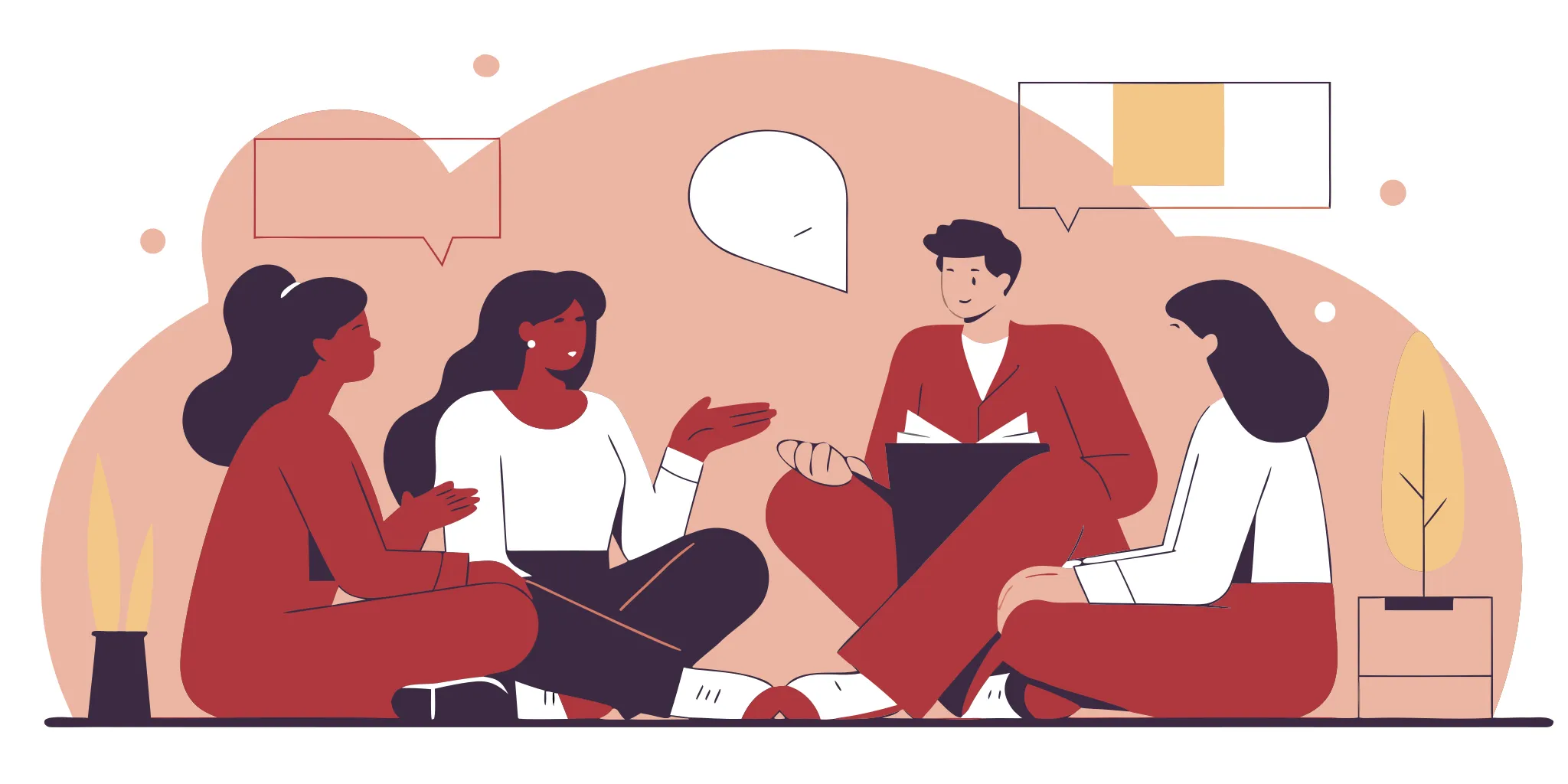
A team can look calm on the surface while important questions, concerns, and ideas stay unspoken. That silence slows learning and makes small problems harder to solve. For managers, creating a healthier team environment starts with making it safe to contribute before every answer is polished.
Schedule a free consultation. Discover how Bunch's peer-learning groups help leaders build the habits that create psychological safety on your team.
Psychological safety is the shared belief that team members can take interpersonal risks, such as asking questions, admitting mistakes, or challenging an idea, without being punished or humiliated. Research links it with team learning behavior and stronger performance, which makes it a practical leadership responsibility rather than a vague culture goal.
Building that kind of trust does not require a dramatic culture overhaul. It grows through everyday signals: how you respond when someone raises a concern, whether you invite quieter voices into the conversation, and what happens after a mistake. Start by understanding what psychological safety looks like in practice, why it matters, and where your team's current habits may be creating silence.
What Is Psychological Safety and Why Does It Matter?
Psychological safety is the shared belief that a team is safe for interpersonal risk-taking. Google's Project Aristotle found it was the strongest predictor of high-performing teams. Teams with high psychological safety learn faster, catch problems earlier, and generate more original ideas because people contribute honestly instead of managing their image.
Amy Edmondson, a professor at Harvard Business School, developed the concept to describe whether people feel able to ask questions, challenge an idea, admit a mistake, or raise a concern without being punished or humiliated. It does not mean avoiding accountability or making every interaction comfortable. It means people can contribute honestly while the team stays focused on learning and doing better work.
Google's Project Aristotle identified psychological safety as the strongest predictor of high-performing teams. A team cannot spot risks it is afraid to discuss, improve a process it cannot question, or generate original ideas if people are managing their image instead of solving the problem.
In a study of 51 work teams, Edmondson found that psychological safety was associated with team learning behavior, and that learning behavior mediated the relationship between safety and team performance. Safety supports the conversations and experiments that help performance improve rather than producing performance by itself. Read the Harvard study.
A useful analogy from research published in PubMed is that psychological safety is the engine of performance, not the fuel. Fuel includes skills, resources, goals, and effort. The engine is what helps a team turn those inputs into learning, coordination, and results. Without it, even a talented team can stall because important information stays unspoken. Review the research on psychological safety and team performance.
The need is especially clear in leadership groups. Research from the Center for Creative Leadership found significant variability in psychological safety among 62% of senior teams studied. Team members may not experience the same meeting, feedback culture, or leader response in the same way. Leaders should treat safety as a team practice, not an assumption.
Bunch's peer-learning community model gives leaders a practical place to practice that behavior. Small, structured conversations let people compare experiences, ask honest questions, and learn from challenges without waiting for a high-stakes meeting. For more on how structured peer conversations strengthen trust, explore how peer-to-peer learning scales manager onboarding.
Signs Your Team May Be Lacking Psychological Safety
When psychological safety is low, team members often stay quiet, protect themselves from blame, and avoid the interpersonal risk that helps a group learn. The most common signs include silence replacing useful disagreement, blame following every mistake, and a scarcity of new ideas and diverse opinions.
Harvard Business Review describes one clear pattern: people suppress their thoughts to avoid social disapproval. That silence can look calm on the surface while important concerns stay unspoken.
- Silence dominates meetings: concerns surface only in private conversations after the meeting ends.
- Mistakes trigger defensive reactions: the first question is who to blame, not what to learn.
- Diverse opinions are absent: team members with different perspectives stay quiet or are dismissed quickly.
- Stretch assignments go unfilled: people avoid visible risks because the personal cost of being wrong feels too high.
- Feedback flows one way: only leaders give input; team members rarely push back or offer alternatives.
- Ideas are recycled: the same few approaches get repeated because no one proposes anything new.
- Turnover hints at deeper issues: departing employees describe feeling unheard or punished for speaking up.
Low vs. High Psychological Safety in Teams| Low Psychological Safety | High Psychological Safety |
|---|
| Silence dominates meetings; concerns surface only in private. | Ideas and concerns are shared openly during discussions. |
| Mistakes trigger blame and defensiveness. | Mistakes are examined to improve the process, not punish the person. |
| Diverse opinions are absent or dismissed quickly. | Disagreement is treated as useful input, not conflict. |
| People avoid stretch assignments and new ideas. | Team members take calculated risks and share creative approaches. |
| Feedback flows one way, from leaders to employees. | Feedback is mutual and expected in both directions. |
High turnover can be another warning signal, especially when departing employees describe feeling ignored, punished for speaking up, or unable to influence decisions. It is not proof of low psychological safety on its own, but it deserves a closer look alongside silence, blame, and risk avoidance. The strongest teams make ideas easy to share, concerns safe to raise, and learning more important than appearing infallible.
Emotional intelligence plays a major role in creating that kind of environment. Leaders who recognize their own emotional patterns and those of their team are better equipped to respond to silence and defensiveness. Read more about emotional intelligence in leadership and why EQ beats IQ for building safer teams.
How Leaders Can Build Psychological Safety on Your Team
Psychological safety does not come from telling people to speak up. It grows when leaders frame work as learning, acknowledge their own fallibility, respond with curiosity, and create reliable structures for every voice to be heard. Consistency matters more than a single exercise because trust builds through repeated, observable signals.
High-performing teams need this safety because people must be able to share ideas, questions, concerns, and mistakes without fearing punishment or humiliation, as Harvard Business Review explains. The following practices give leaders a repeatable approach.
Frame the work as a learning problem. When a project goes off track, avoid treating the outcome as proof that someone failed to execute. Instead, name the uncertainty the team is trying to resolve. Ask: "What are we learning about the customer, process, or constraint?" This framing makes it easier to surface weak signals before they become expensive problems. It also shifts the conversation from defending past decisions to improving the next one.
Acknowledge your own fallibility. Go first. Say what you do not know, identify an assumption that may be wrong, or explain where you need help. The HBR guidance on building psychological safety specifically highlights acknowledging a leader's own fallibility as a foundation for participation. You do not need to undermine your authority. You need to show that expertise and uncertainty can exist together.
Model curiosity when people speak up. Respond to difficult input with questions before conclusions. Try: "What led you to that concern?" or "What are we missing?" When someone makes a mistake, focus first on the conditions and decisions behind it, not on assigning blame. Thank people for raising issues, then follow through visibly. If speaking up leads to dismissal, sarcasm, or no action, the team will learn to stay quiet.
Create structured opportunities for every voice. Open discussion often favors the fastest or most senior speakers. Use a round-robin at key meetings so each person can contribute, and offer anonymous feedback for sensitive topics. Invite written input before a decision, then address the themes you receive. Structure is especially important for remote and hybrid teams, where silence can be mistaken for agreement.
Build delegation into the trust cycle. Assigning meaningful responsibility sends a clear signal that you trust your team's judgment. When people are trusted with real decisions, they are more likely to speak up about risks and ideas. Learn more about delegation skills for managers to reinforce safety through everyday leadership habits.
Repeat these behaviors consistently. A single listening session cannot compensate for months of defensive reactions, but small, predictable signals can change what your team believes is safe to say. Conflict will still arise in any team, but the way you handle it determines whether disagreement strengthens or weakens trust. Explore conflict resolution strategies for managers for practical approaches.
Practical Exercises to Strengthen Team Psychological Safety
Psychological safety exercises for teams work best when they become brief, repeatable habits. The goal is not to manufacture agreement. It is to make it easier for people to ask questions, surface risks, and learn from one another without fear of embarrassment or blame.

Start with an inclusive check-in. At the beginning of a meeting, give each person a consistent opportunity to speak. Ask a focused question such as: "What is one risk, question, or win you want the team to know about?" Let people pass, but avoid allowing the most senior voices to answer first every time. Rotate who opens the discussion, and notice whose perspective has not yet been heard.
Turn post-mortems into learning reviews. After a project or incident, separate the outcome from the person. Ask what the team expected, what actually happened, which signals were missed, and what should change next time. End with one or two concrete actions and an owner. When managers acknowledge their own uncertainty and ask curious questions, a post-mortem becomes a practice field for honesty rather than a search for someone to blame.
Use start, stop, continue rounds. Invite each participant to name one behavior the team should start, one it should stop, and one it should continue. Collect responses verbally or anonymously, then discuss themes rather than guessing who said what. The manager should go first and commit to a visible change. This makes feedback mutual and specific, instead of turning it into a one-way performance review.
Build peer learning into the rhythm. Peer-learning groups give managers a structured place to rehearse listening, disagreement, and supportive feedback. Bunch's communities reinforce social learning and accountability, while its 13 leadership archetypes help people recognize different communication strengths and growth areas. Learn about the 13 leadership archetypes and how they shape your management style.
Bunchee can add personalized guidance between conversations. A two-minute daily microlearning tip is small enough to repeat consistently, and Bunch reports an 83% completion rate for this format. Use each tip as a prompt for a quick team discussion, then revisit what changed. For more on this approach, see microlearning for managers to build daily leadership habits.
Building Psychological Safety in Remote and Hybrid Teams
Psychological safety in remote teams grows when managers make participation visible, predictable, and easy across different communication preferences. Intentional over-communication helps close the gap created by the loss of in-person signals like facial expressions and quiet side conversations.
In an office, hesitation may show up through a pause, facial expression, or quiet conversation after a meeting. On video calls, those signals are harder to read. Some people may also feel less comfortable interrupting, disagreeing publicly, or admitting confusion while everyone is watching. The leader's job is to design for that constraint rather than expecting candor to happen naturally.
Intentional over-communication helps close that gap. Before a meeting, share the decision to be made and invite questions in writing. During the call, pause after asking for input. Name the people who have not spoken yet without putting them on the spot, and offer a chat or follow-up option. Afterward, summarize decisions, unresolved concerns, and how people can add context asynchronously.
Create channels for feedback between meetings. Give team members more than one way to raise a concern. A shared feedback document, private manager form, or dedicated Slack channel can help someone contribute after they have had time to think. Make the response visible when appropriate. If a suggestion changes the plan, explain why. If it does not, acknowledge it and give a clear reason rather than letting the feedback disappear. For guidance on leading remote teams effectively, explore how to lead distributed teams in 2026.
Make virtual check-ins a leadership habit. Use brief one-on-ones and team check-ins to ask questions such as: "What feels unclear?" and "What risk are we not discussing?" Keep the format consistent. Remote employees should know when and where they can speak up. Bunch can reinforce that rhythm with personalized daily leadership tips, peer-learning groups, and guidance from Bunchee. Its app-based microlearning is accessible anywhere, helping managers practice small, repeatable behaviors instead of waiting for an annual training session. Discover how AI coaching for leadership helps managers build daily skills.
Book a demo with Bunch. See how daily microlearning and peer groups help leaders build psychological safety across distributed teams.
Frequently Asked Questions
What is psychological safety in a team?
Psychological safety is a shared belief that team members can take interpersonal risks without being punished or humiliated. In practice, people can ask questions, share concerns, admit mistakes, and offer ideas even when they are unsure how others will respond. It does not mean avoiding accountability or agreeing all the time. It means making honest participation safe enough for the team to learn and solve problems together. Harvard research defines the concept as safety for interpersonal risk-taking.
Why is psychological safety important for high-performing teams?
Teams make better use of their expertise when people speak up early about risks, gaps, and new possibilities. That input supports learning, problem-solving, and adaptation instead of allowing small issues to remain hidden. Psychological safety is not a substitute for clear goals or strong execution. It creates the conditions that help a team use both. Research on 51 work teams found that learning behavior helped connect psychological safety with team performance. Read the original study.
How do you build psychological safety on your team?
Start by framing difficult work as a shared learning problem, then invite specific questions and dissenting views before decisions are finalized. Leaders should acknowledge what they do not know, listen without interrupting, and respond to mistakes with curiosity before assigning blame. Close the loop by explaining what happened to people's feedback, even when you do not adopt every suggestion. Consistency matters more than a single team exercise because trust grows through repeated, observable responses.
What are the signs of low psychological safety in a team?
Common signs include silence in meetings, concerns raised only in private, limited disagreement, repeated avoidable mistakes, and a tendency to blame individuals rather than examine the process. Team members may also stop asking for help or challenging assumptions because they expect embarrassment or social disapproval. Treat these patterns as signals to investigate, not proof that a person or group is the problem. Ask where people feel unable to speak freely, and look for ways leaders can make responses safer and more predictable.
Ready to build psychological safety on your team?
Small, consistent leadership habits can make it easier for people to speak up, learn from mistakes, and contribute with confidence. Bunch helps you keep leadership growth practical through daily guidance, peer learning, and support from Bunchee, the AI coach. Start building psychological safety on your team with Bunch and explore the plan that fits your goals.